|
I am a PhD student at Mila, Université de Montréal, where I am advised by Pablo Samuel Castro. I completed my BS and MS at Cornell University, where I was advised by Wen Sun. |

|
|
I'm primarily interested in (deep) reinforcement learning, imitation learning, and deep generative models. |
|
|
|
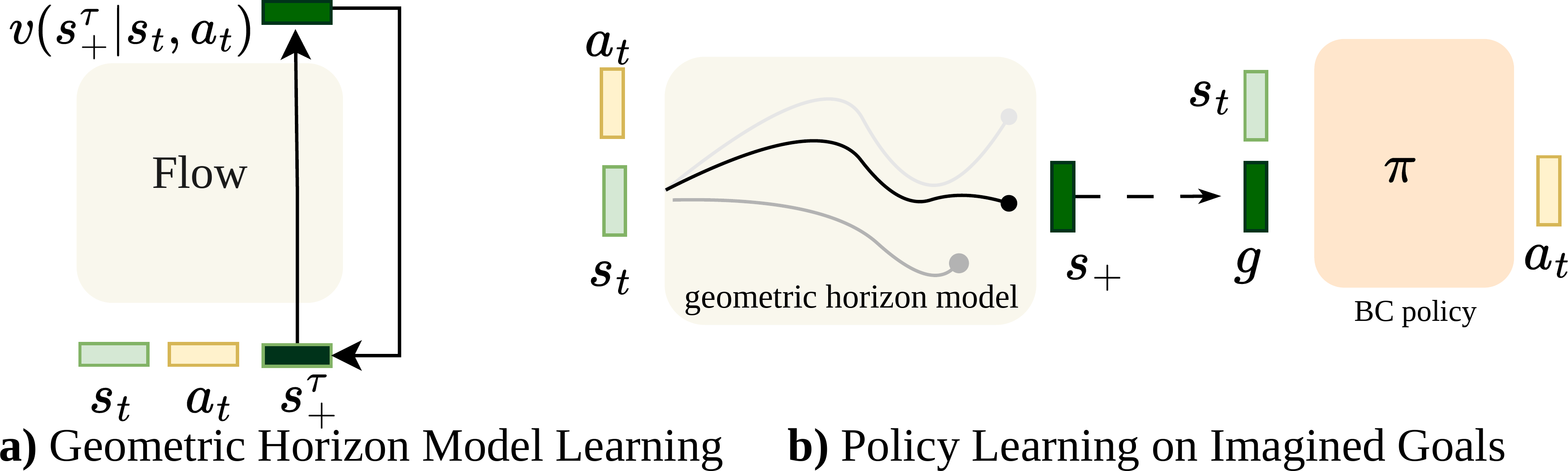
Daniel Lawson, Dhruv Sreenivas, Adriana Hugessen, Khimya Khetarpal, Glen Berseth RL Beyond Rewards Workshop, RLC 2026 arXiv We improve generalization in goal-conditioned behavior cloning policies via sampling goals from a geometric horizon model, allowing for experience across trajectories to be stitched together to provide useful goals for conditioning. |

|
Olya Mastikhina*, Dhruv Sreenivas*, Pablo Samuel Castro RLC 2025 arXiv We find that making the critic "optimistic" in actor-critic learning (e.g. by doing Q value reduction differently) significantly improves downstream performance of much smaller actors across a variety of control domains. |

|
Jonathan Chang, Dhruv Sreenivas*, Yingbing Huang*, Kianté Brantley, Wen Sun ICLR 2024 arXiv By viewing off-policy adversarial imitation learning through the framework of gradient boosting, we develop a novel, theoretically principled algorithm that outperforms state-of-the-art methods. |

|
Shachi Deshpande, Kaiwen Wang, Dhruv Sreenivas, Zheng Li, Volodymyr Kuleshov NeurIPS 2022 arXiv We leverage advances in deep learning to propose a universal multimodal deconfounder for causal inference, with applications in genome-wide association studies (GWAS). |

|
Jonathan D. Chang*, Masatoshi Uehara*, Dhruv Sreenivas, Rahul Kidambi, Wen Sun NeurIPS 2021 code / arXiv We leverage offline data with partial coverage over the expert state distribution to mitigate the covariate shift problem in imitation learning. |
|
|
|
Website template is from Jon Barron's website. |